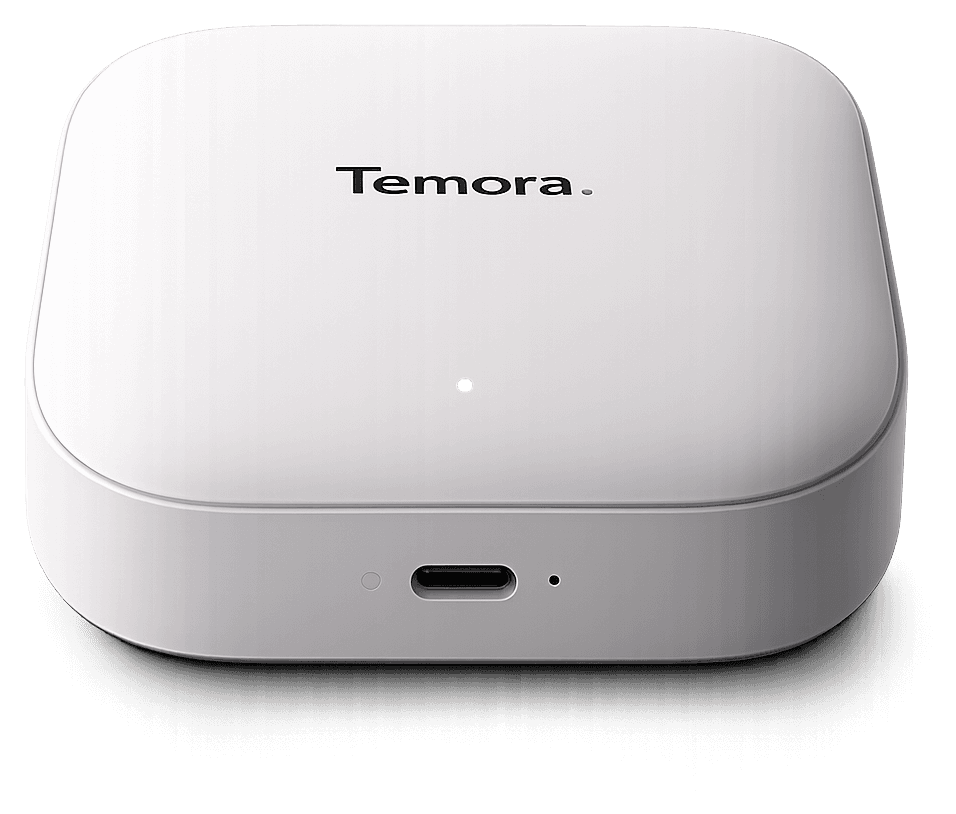
A small hub. A simpler measurement routine.
The hub sits next to the patient's medical devices and sends each new reading to your platform. Around it, TEMORA reviews your devices, integrates with your platform and supports the deployment.
Configured at deployment. Simple every day.
The hub, the patient's devices and the home connection are configured once, when the patient joins your program. From then on, the routine is the measurement.
At deployment
Configured for the patient
Hub, devices and home Wi-Fi are set up together. Your deployment plan names who does it: your team, a field partner, or your staff with guidance from TEMORA.
Every day
The patient takes the measurement
With their own device, following the manufacturer's instructions. The hub picks up the reading. No smartphone is needed.
In your platform
The reading arrives
With the same fields as every other device in your program, in the tools your team already uses.
What's included, and what's yours.
A clear split from the first conversation, documented in the deployment scope.
TEMORA provides
- Home hubs prepared for your program
- Device connection work scoped around your selected models
- Readings delivered to your platform in the agreed format
- Support through integration, technical evaluation and deployment
Your organization keeps
- The program and the patient workflow
- The receiving platform, or the software you choose
- Clinical records and every care decision
- Onboarding and support ownership, agreed with us
The essentials for your evaluation.
Device connectivity, patient routine and integration at a glance. How integration works
- Connects to
- Medical devices from multiple brands, over Bluetooth Low Energy
- Internet connection
- Wi-Fi at the patient's home
- Readings go to
- Your platform, through an integration agreed with your team
- Data format
- One consistent structure for every connected device
- Patient's daily task
- Take the measurement
- Patient smartphone
- Not required
- Device models
- Reviewed for your program as part of the deployment scope
- Security review
- Part of the integration scope
Why a hub instead of another app.
An app can work for patients at ease with their phone. With a hub, readings don't depend on a phone being nearby, charged, connected and up to date.
A hub moves those steps out of the patient's hands. For your team, that means fewer app and pairing questions to answer, and one program you can offer to patients with very different comfort levels with technology. Read the decision guide
- No app to install, update or sign in to
- No pairing to redo
- No reading to send by hand
- No phone that has to stay nearby
Questions about the hub.
For the details of data delivery and security, see the integration page.
Does the patient need a smartphone?
No. The patient uses their medical device and the hub handles the transmission, so the routine works for patients who don't own a smartphone.
How does the hub connect to the internet?
Through Wi-Fi at the patient's home, configured at deployment.
Can one hub handle several devices?
Yes. One hub connects the devices used in your program, across brands. The device combination for each patient is prepared as part of your deployment.
Who supports patients if something goes wrong?
Your deployment plan specifies patient support, replacement equipment and escalation to TEMORA.
Plan hubs for your patients.
Equipping patients, integrating your platform, or both: one request. Or write to [email protected].